

Drying wood is very important in furniture manufacturing because the drying process directly affects the wood’s stability, durability, and quality. If furniture is made without properly drying the wood, its dimensions may change.
Wood absorbs and releases moisture from the natural environment, which is why it can shrink and swell. As a result, problems such as cracks, warping, loose joints, and gaps may develop in furniture. Therefore, before manufacturing furniture, it is important to maintain the timber’s moisture content according to its intended use and surrounding conditions.
Properly dried wood is also helpful during manufacturing. It makes the processes of cutting, machining, joining, and finishing easier, especially when different wood components need to fit together accurately. However, proper drying alone does not guarantee good furniture quality. Wood species, manufacturing techniques, storage, and environmental conditions also matter.
There are two methods of drying timber: kiln drying and air drying. The drying time, process, moisture content achieved through each method, and the ability to control that moisture content can differ. In this article, we will understand how both methods work and why choosing the right drying method is important for furniture manufacturing.
What Is Kiln-Dried Wood?
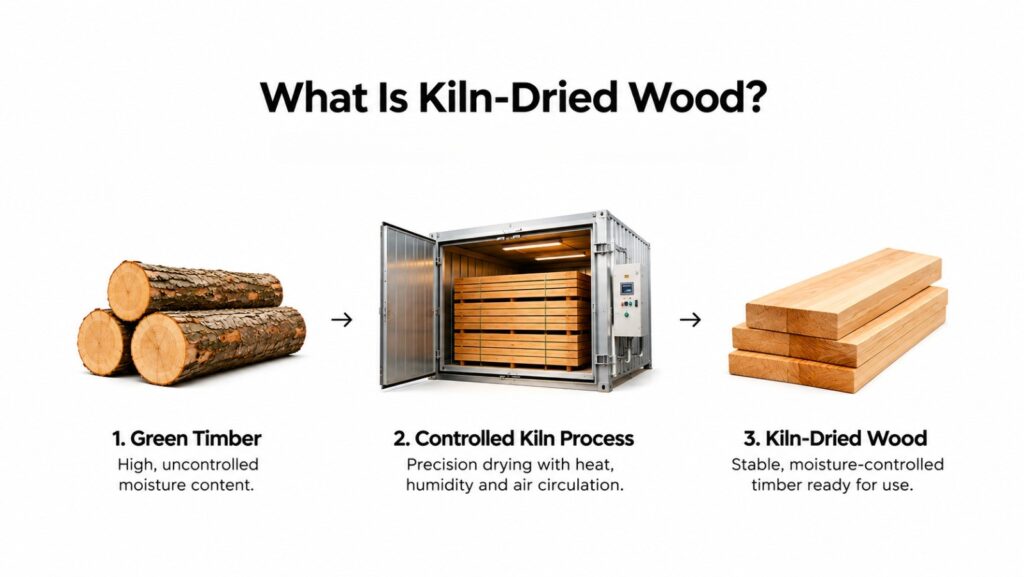
Kiln-dried wood is timber that is properly dried inside a specially designed drying chamber, known as a kiln, under controlled temperature, humidity, and air circulation. The main purpose of this process is to dry the wood and control its moisture content to a level suitable for furniture manufacturing or another intended use. The process involves more than simply drying the wood moisture must be removed carefully to reduce the risk of unnecessary splitting, cracks, and other drying defects inside the timber.
When timber is dried in a kiln, heat and proper air circulation remove moisture from the wood. During drying, the temperature and humidity must be managed according to the wood species, thickness, and initial moisture content. If wood is dried too quickly or under unsuitable conditions, surface or internal splitting, cracks, and other stresses may develop. Therefore, proper wood drying involves not only achieving a suitable moisture level but also maintaining the quality of the timber.
At BFP, kiln-dried timber is processed under controlled drying conditions. Temperature and humidity are carefully managed to bring the wood’s moisture content to the required level. For interior applications, 6–8% is a typical target range, while 10–14% is typical for exterior applications. However, the correct level depends on the timber species and the conditions where it will be used. BFP offers premium kiln-dried wood in different wood species, grades, and custom dimensions, allowing furniture manufacturers to select suitable material according to their production requirements.
What Is Air-Dried Wood?
When wood is dried naturally in the air and environment instead of being dried in an artificial kiln, it is called air-dried wood. This is the oldest and most traditional method of drying timber. Freshly cut or sawn wood planks are stacked with stickers between them so that natural, fresh air can flow around every piece of wood. The timber is then stored for a long period in an open area with proper airflow while being protected from rain and strong, direct sunlight. This allows natural air and warmth to gradually evaporate the moisture.
The speed at which timber dries through air drying depends on humidity, wood species, temperature, airflow, and board thickness. Some wood species dry quickly, while others dry slowly and need more time. Temperature and board thickness also matter for example, thicker boards take longer to dry. Therefore, all wood species cannot be expected to dry in the same amount of time. Compared with kiln drying, air drying offers limited control over the process and moisture content because outdoor weather conditions cannot be controlled.
However, simply keeping timber in the open air for a long time does not guarantee that its moisture level has been reduced sufficiently for furniture manufacturing. Therefore, it is important to check the actual moisture content with a moisture meter and prepare the timber according to its intended use environment.
Kiln-Dried vs. Air-Dried Wood: Key Differences
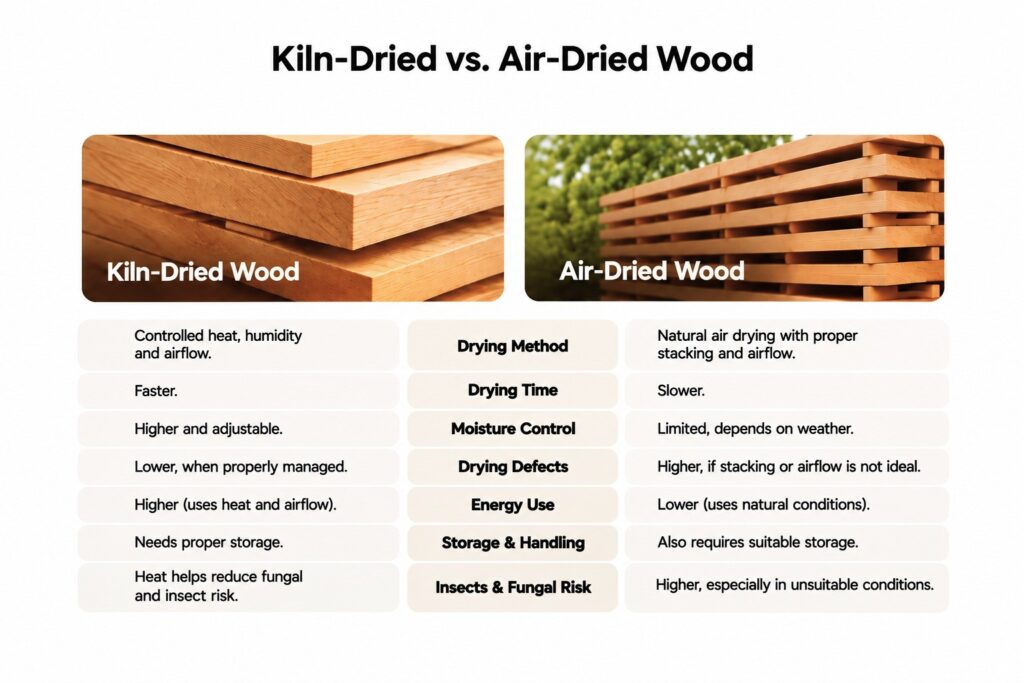
When selecting timber for woodworking or furniture manufacturing, it is important to understand the difference between kiln drying and air drying. Both methods control the moisture inside wood through different processes. Let us understand the key differences between kiln-dried and air-dried wood:
How Wood Drying Affects Furniture Performance
Furniture performance depends not only on the wood species and manufacturing quality moisture control also plays an important role. Wood absorbs and releases moisture from its surrounding environment. When the moisture content changes, the wood’s dimensions may also change. Therefore, timber must be dried to an appropriate level before furniture is manufactured.
When wood is dried to an indoor moisture standard, it becomes more stable. However, if excess moisture remains inside the wood and it is used to make furniture, the wood may shrink when placed in a dry environment. This can create gaps in furniture panels and joints.
Joints play an important role in furniture strength. Properly dried timber helps create accurate fits and strong joints. However, if wood with an unsuitable moisture content is used, the joints may become loose or develop gaps later because of shrinkage. Therefore, it is important to maintain the wood’s moisture content at a suitable level during furniture manufacturing.
If wood is dried under uneven or improper conditions, internal stresses and drying defects may develop. Later, changes in temperature and humidity can cause the wood’s dimensions to change, resulting in warping and other problems. A proper drying process helps reduce these risks and improves the furniture’s dimensional stability. However, even after drying, it is important to store the wood under suitable environmental conditions.
Therefore, proper and suitable wood drying is important for better furniture performance. If wood is properly dried according to environmental conditions and its intended use, it can perform very well.
Which Drying Method Is Better for Furniture Manufacturing?
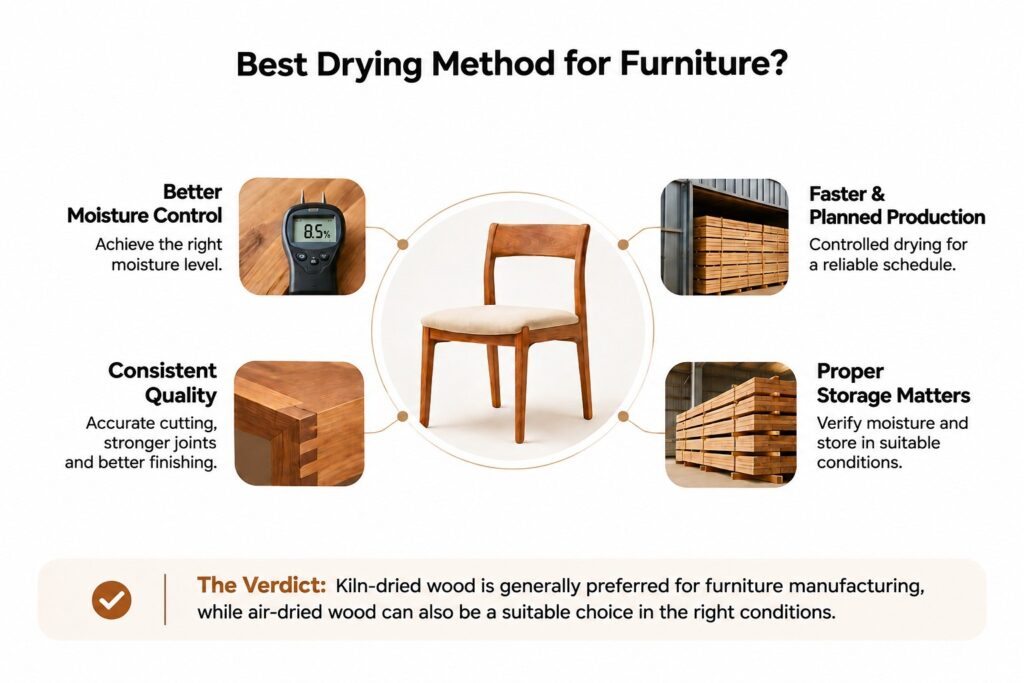
When it comes to high-quality furniture manufacturing, the kiln-drying method is generally considered the more suitable option. However, this does not mean that furniture cannot be made from air-dried wood. Both methods are useful. The right choice should be based on the timber species, thickness, intended application, and environment where the finished furniture will be used.
The biggest advantage of kiln drying is that wood is dried under controlled temperature, humidity, and airflow. This makes it comparatively easier to achieve the required moisture content and plan the production schedule. This is important in furniture manufacturing because wooden components must be cut to accurate dimensions, joints must fit properly, and consistent finishing must be achieved.
Another important factor is that kiln-dried timber is not automatically defect-free or permanently stable. If the drying schedule is not properly planned, cracks, splitting, internal stresses, and distortion may develop in the wood. Similarly, if timber is placed in a humid atmosphere after kiln drying, it can absorb moisture again. Therefore, moisture verification, the environment where the furniture will be used, and proper storage are equally important when selecting timber.
Overall, kiln drying is a preferred choice for furniture manufacturing, especially when precise moisture control and predictable production are priorities. Air drying can be effective for initial moisture reduction or direct use under suitable conditions. However, the final decision should be based on the timber’s intended use and moisture content.
The BFP Advantage: Precision Kiln-Dried Timber Solutions
When you choose BFP for your furniture manufacturing and architectural projects, you receive more than raw wood. You also receive nearly seven decades of trust and quality that meets international standards. The main advantages of timber supplied by BFP include:
- BFP has advanced and modern kiln-drying facilities where wood is processed under controlled conditions with proper airflow and relative humidity. This allows the timber’s moisture content to be precisely controlled at 6–8%, which is considered ideal for furniture manufacturing and cabinetry.
- Every piece of timber undergoes strict grading and moisture checks so that the risk of cracks, warping, and pest damage is minimized. This helps your furniture remain strong and attractive for a long time.
- Whether you need hardwood for premium furniture and architectural joinery or a suitable timber grade for a specific application, BFP offers different wood species and grade options. In addition to standard sizes, custom dimensions can also be discussed, making it easier to plan timber selection according to the project’s needs.
- From timber selection to material application, the BFP team provides proper guidance. You are advised on which drying method and timber to use for each project so that material waste can be minimized.
- For large commercial projects, resort construction, or continuous furniture manufacturing where you need large quantities of timber with consistent quality, BFP’s supply chain network helps ensure a reliable supply.
Conclusion
The success of furniture manufacturing and woodworking depends on the type of timber and drying method you use. As we have seen, air-dried wood can be suitable for traditional applications and outdoor work. However, when it comes to modern, long-lasting furniture, kiln drying is generally more useful. It provides precise moisture control and can help reduce the risk of fungal and insect damage, allowing your furniture to last longer and perform better.
BFP offers kiln-dried timber in different wood species, grades, and custom sizes for furniture, cabinetry, flooring, doors, and other woodworking applications. BFP kiln-dried timber typically has a moisture content of 6–8% for interior applications and 10–14% for exterior applications. However, the actual requirement varies according to the environment, project, and wood species.
Frequently Asked Questions (FAQs)
Kiln-dried wood is generally considered the better option for furniture manufacturing because it is dried in a controlled environment and its moisture content can be controlled according to indoor conditions. This helps reduce the risk of warping, cracking, and shrinking later.
Both drying methods have their own advantages. The main advantage of kiln-dried wood is that its moisture content can be controlled and the drying process is faster. Air drying is a natural process, but drying time and moisture content vary according to weather and surrounding humidity. Kiln-dried wood is commonly used for interior applications, while air-dried wood is often used outdoors. Therefore, it cannot be said that one method is always better than the other.
For indoor furniture and fine cabinetry, the ideal moisture content is generally between 6% and 8%. This range matches typical indoor conditions in homes and offices and helps furniture joints and panels perform well over the long term.
Kiln drying does not take a fixed amount of time. The duration depends on the wood species, thickness, starting moisture content, and the temperature, humidity, and airflow used in the kiln. Some timber can dry relatively quickly, while thicker boards and species that are more difficult to dry may take considerably longer. There is no single exact drying time.
Yes, kiln-dried wood can be used for outdoor furniture. However, kiln drying alone does not make wood weatherproof. It is important to choose a suitable wood species and use protective finishes and treatments. The amount of exposure to rain, humidity, and other weather conditions should also be considered.
The main disadvantage of kiln drying is that it consumes energy, so it generally costs more than air drying. Another disadvantage is that if the drying process is not properly managed, sudden heat can cause cracks and stresses in the wood. A proper drying schedule and quality control are therefore important for good results.
If kiln-dried wood gets temporarily wet, it generally does not suffer significant effects after drying. However, if it remains wet or exposed to high humidity for a long time, it may swell. This can cause movement after the wood dries. Repeated dampness can also increase the risk of fungal growth and decay.
You cannot confirm whether wood is kiln-dried or air-dried simply by looking at its colour, appearance, or touching it. The most practical method is to use a moisture meter to check its moisture level. Kiln-dried wood may also have a clean and uniform surface, without signs of insects or fungi. Drying records or confirmation from the supplier are more helpful for verifying the process.