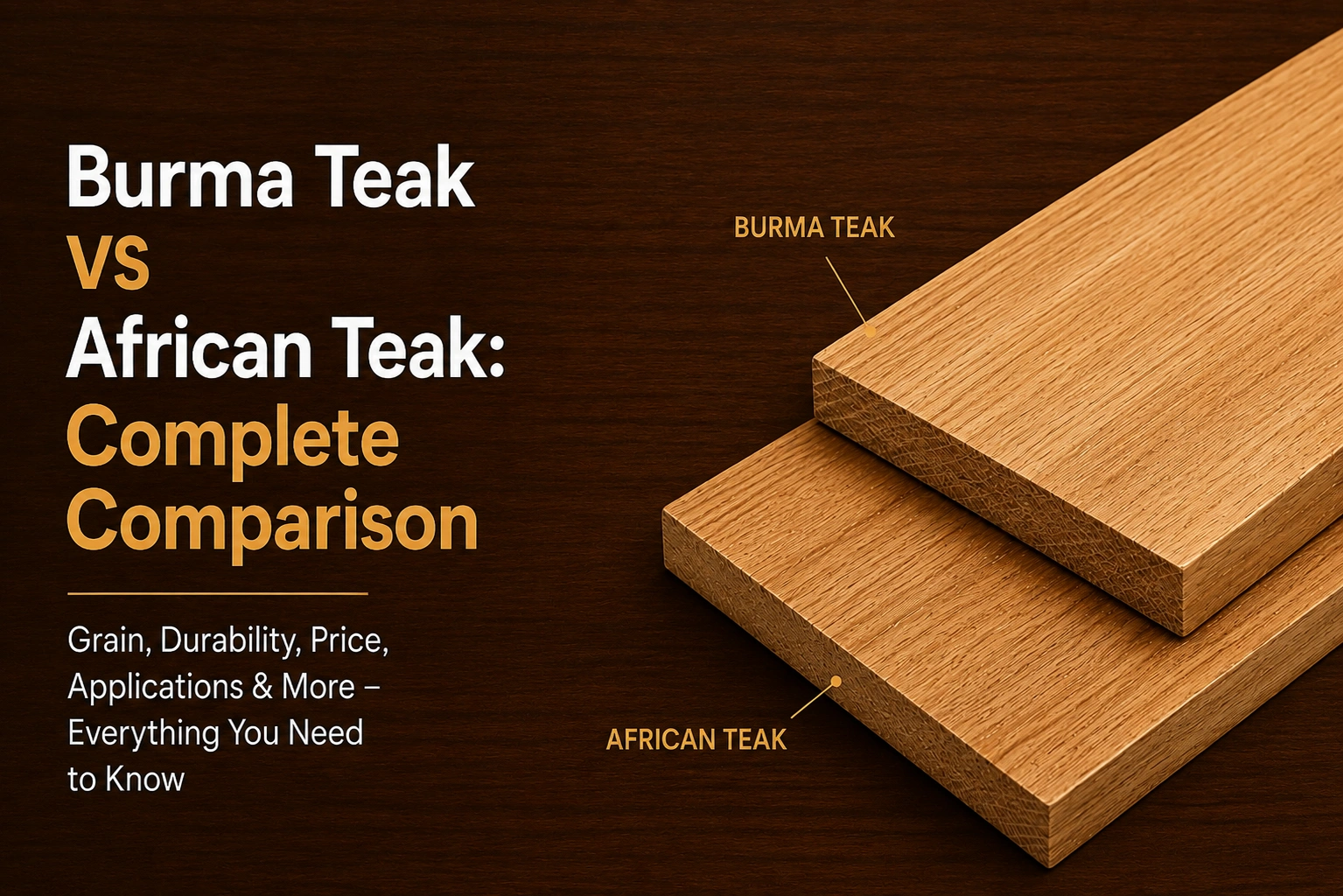
Burma teak vs African teak is an important comparison for architects, furniture manufacturers, builders and homeowners choosing premium timber. Burma teak is genuine Tectona grandis associated with Myanmar, while the term African teak can refer to African-grown teak or, in some markets, iroko sold as “African teak.” Always verify the botanical name before buying.
What Is Burma Teak?
Burma teak, commonly associated with Myanmar teak, is a premium form of Tectona grandis. It is valued for its rich golden-brown to brown appearance, natural oils, durability, dimensional stability and attractive grain.
Teak has a long history of use in demanding applications because its natural properties make it suitable for furniture, doors, outdoor applications, architectural elements and marine environments.
Its combination of appearance and performance is one reason genuine teak continues to occupy a premium position in the timber market.
What Is African Teak?
The term African teak needs careful attention because it is not always used consistently.
In the timber trade, it can refer to:
- True teak (Tectona grandis) grown in Africa, particularly plantation-grown teak.
- Iroko (Milicia excelsa or Milicia regia), which is commonly marketed as African teak even though it is botanically different from true teak.
This distinction matters when comparing Burma teak with African teak.
If a supplier describes timber simply as “African teak,” ask for the botanical name, country of origin, grade and product documentation before making a purchasing decision.
Burma Teak vs African Teak: Key Differences
| Feature | Burma Teak | African Teak / Iroko |
|---|---|---|
| Botanical identity | Tectona grandis | Often Milicia excelsa / M. regia when sold as iroko |
| Origin | Myanmar / Southeast Asian teak region | Tropical Africa for iroko |
| Colour | Golden brown to medium/deep brown | Yellow-golden to medium brown |
| Grain | Usually straight to moderately interlocked | Often interlocked |
| Texture | Moderate | Medium to coarse |
| Natural oils | High | Lower than true teak |
| Durability | Excellent | Very good to excellent |
| Dimensional stability | Excellent | Good to very good |
| Workability | Generally good | Good, but interlocked grain can require care |
| Typical positioning | Premium | Alternative / application dependent |
| Suitable applications | Furniture, doors, outdoor & marine uses | Furniture, flooring, doors, joinery, outdoor uses |
Iroko is a durable African hardwood and is widely recognised as an alternative to genuine teak, but it should not be treated as the same species.
1. Appearance and Grain
One of the first differences buyers notice is appearance.
Burma Teak
Burma teak generally has a warm golden-brown to brown colour that can become richer with age. Its grain can be straight, wavy or occasionally interlocked.
Its relatively refined appearance makes it particularly attractive for premium furniture, doors and high-end interiors.
African Teak / Iroko
Iroko generally ranges from yellow or golden brown to medium brown and tends to darken with exposure. Its grain can be interlocked and its texture is generally coarser than teak.
Best for refined luxury appearance: Burma teak.
2. Durability
Both woods can provide strong performance when correctly specified, seasoned, manufactured and maintained.
True teak is particularly well known for its natural resistance to decay, moisture and insects. Its natural oils contribute to its performance in demanding environments.
Iroko is also regarded as a durable timber with good resistance to rot and insect attack, making it suitable for interior and exterior applications.
Best for premium durability: Burma teak.
Strong alternative: African teak/Iroko for suitable applications.
3. Dimensional Stability
Dimensional stability is particularly important for:
- Doors
- Window frames
- Furniture
- Outdoor furniture
- Architectural joinery
- Large timber components
Teak’s stability is one of its most valued characteristics.
Iroko also has relatively low shrinkage and can perform well when properly seasoned and installed.
For precision furniture and premium architectural joinery, the timber’s moisture condition and manufacturing process are just as important as the species itself.
4. Workability
Both materials can be machined and finished for furniture and architectural applications.
Teak generally works well, although its natural oils can affect some gluing and finishing processes.
Iroko is also workable, but its interlocked grain can cause tear-out during machining. Mineral deposits sometimes found in iroko can also affect cutting tools.
For manufacturers, machining conditions and tooling should therefore be considered during project planning.
5. Applications
Burma Teak
Burma teak is particularly suitable for:
- Luxury furniture
- Premium doors
- Architectural joinery
- Outdoor furniture
- Decking
- High-end interiors
- Marine applications
African Teak / Iroko
Iroko can be used for:
- Furniture
- Flooring
- Doors
- Windows
- Cabinetry
- Panelling
- Outdoor joinery
- Boatbuilding
Iroko’s established use across interior and exterior joinery makes it a practical alternative for applications where teak-like performance and appearance are desired.
Burma Teak vs African Teak: Which Is Better for Furniture?
For luxury furniture, Burma teak is generally preferred when the project prioritises premium appearance, natural oil content, refined grain and established teak performance.
African teak/Iroko can be considered when the project requires a durable hardwood with an attractive natural appearance and the specification permits an alternative to true teak.
The correct choice depends on:
- Furniture design
- Indoor or outdoor use
- Desired colour
- Grain preference
- Budget
- Availability
- Required durability
- Finishing system
Which Is Better for Doors?
Both can be suitable for doors, but the application should determine the specification.
For high-end residential doors where natural grain, premium appearance and long-term performance are priorities, genuine teak is a strong option.
African teak/Iroko can also be considered for doors and exterior joinery because of its durability and stability.
For Indian projects, professionals may also evaluate MP Nagpur Teak wood, which is valued for its durability, grain and suitability for furniture, doors and architectural interiors.
What About Plantation Teak?
Plantation teak wood is another important category to consider.
Plantation-grown teak is cultivated under managed growing conditions and can offer a more accessible supply option compared with premium old-growth material.
However, plantation teak is not automatically identical in appearance or performance to every other teak category. Growth rate, age, site conditions, grading, moisture content and processing can influence the final timber characteristics.
Therefore, buyers should evaluate the actual timber specification rather than choosing solely based on the word “teak.”
How to Choose Between Burma Teak and African Teak
Step 1: Identify the Botanical Name
This is particularly important when the term “African teak” is used.
Ask whether the product is:
- Tectona grandis
- Milicia excelsa
- Milicia regia
- Another species
This prevents buying a different timber under a confusing trade name.
Step 2: Check the Origin
Ask for the declared country or region of origin and relevant documentation.
Step 3: Inspect the Grain
Look for the grain characteristics appropriate to your design.
Step 4: Check Moisture Condition
Properly conditioned timber is essential for dimensional stability after manufacturing and installation.
Step 5: Match Timber to the Application
Choose based on whether the timber will be used for furniture, doors, flooring, outdoor applications, architectural joinery or another purpose.
Step 6: Compare Total Value
Do not compare only the purchase price.
Consider:
- Processing requirements
- Wastage
- Maintenance
- Expected service life
- Finishing requirements
- Availability
Also Read: Difference Between Teak Wood and Thermo wood
Common Mistakes When Buying Teak
Mistake 1: Assuming Every “Teak” Is the Same
True teak and woods marketed as African teak may be botanically different.
Mistake 2: Buying Without Species Documentation
A professional supplier should be able to clarify the timber species and specification.
Mistake 3: Choosing Only by Colour
Colour can vary naturally and is not sufficient proof of species or quality.
Mistake 4: Ignoring Moisture Content
Poorly conditioned timber can develop movement after installation.
Mistake 5: Comparing Only Price
Lower purchase cost does not necessarily mean lower overall project cost.
Expert Recommendation: Which Should You Choose?
For premium architectural projects where the priority is genuine teak performance, refined appearance and long-term value, Burma teak is an excellent choice.
However, African teak/Iroko can be a practical alternative for projects where its characteristics match the application and the specification is clearly documented.
For Indian projects, buyers should also compare Burma teak with Indian and plantation teak rather than treating the decision as a simple two-way comparison.
The most important principle is to verify the species, grade, origin, moisture condition and intended application before purchasing.
Why Choose Bansal Forest Products?
Bansal Forest Products (BFP) is a premium wood supplier in India with an extensive portfolio of teak, imported hardwoods, softwoods, thermo wood, engineered wood, logs and sawn timber.
BFP’s teak portfolio includes multiple options for professionals who need to match timber characteristics with project requirements.
As one of India’s established importers and suppliers of premium timber, BFP serves:
- Architects
- Interior designers
- Furniture manufacturers
- Builders and developers
- Contractors
- Timber dealers
- Hospitality projects
- Commercial projects
For projects where timber species, quality and application need to be evaluated carefully, BFP provides access to multiple wood categories rather than a one-size-fits-all solution.
Key Takeaways
When comparing Burma teak vs African teak, the most important point is that the term “African teak” can describe different materials in the market.
Burma teak:
- Genuine Tectona grandis
- Premium appearance
- High natural oil content
- Excellent durability
- Strong choice for luxury furniture and architectural applications
African teak/Iroko:
- Commonly refers to Milicia species when used as a trade name
- Durable African hardwood
- Attractive golden-brown appearance
- Good exterior and interior applications
- Can serve as an alternative to genuine teak in suitable projects
Always verify the botanical name, origin, grade, moisture condition and intended application before making a purchase.
Frequently Asked Questions
1. Is Burma teak better than African teak?
For premium applications, Burma teak is generally preferred for its refined appearance, natural oils, durability and established performance. African teak/Iroko can be a suitable alternative depending on the application.
2. Is African teak real teak?
Not necessarily. The term can refer to African-grown Tectona grandis, but it is also commonly used as a trade name for iroko (Milicia excelsa or M. regia), which is a different species.
3. Which is better for furniture, Burma teak or African teak?
For luxury furniture, Burma teak is generally preferred when premium appearance and traditional teak characteristics are the priority. Iroko can be suitable where its properties and appearance meet the design requirements.
4. Is African teak good for outdoor use?
Iroko is known for good durability and resistance to rot and insects, making it suitable for various exterior applications when properly specified and finished.
5. How can I identify genuine teak?
Ask for the botanical name, origin and product documentation. Visual characteristics such as grain and colour can help, but they should not be treated as the only method of authentication.
6. Is MP Nagpur teak better than Burma teak?
They are different teak categories. MP/Nagpur teak is Indian Tectona grandis and is valued for durability, appearance and stability, while Burma teak occupies a premium position associated with Myanmar teak. The best option depends on application and specification.
7. Which teak is best for luxury doors?
Genuine teak varieties with appropriate grade, dimensions and moisture condition are strong options for luxury doors. Burma teak, MP/Nagpur teak and suitable plantation teak can all be evaluated according to project requirements.
Conclusion
The Burma teak vs African teak comparison is not simply about deciding which timber is “better.” It is about understanding the species, origin, characteristics and intended application.
Burma teak remains a premium choice for luxury furniture, doors, architectural interiors and demanding applications where genuine teak characteristics are important.
African teak/Iroko provides another durable hardwood option and can be valuable when its properties, appearance and price align with the project.
For architects, furniture manufacturers, builders and homeowners, the safest approach is to purchase timber from a trusted supplier and verify the species, origin, grade and moisture condition before investment.
Get Premium Teak Wood from BFP
Planning a furniture, door, interior or architectural project?
- Visit Us: https://bfppl.com/
- WhatsApp Us: +91-99920 23797
- Email Us: enquiry@bfppl.com